



Aldose Reductase
AKR1B1; Aldo-keto reductase family 1 member B
Aldose reductase is a small, cytosolic, monomeric enzyme which belongs to the aldo-keto reductase superfamily. Aldose reductase catalyzes the reduced form of nicotinamide adenine dinucleotide phosphate (NADPH)-dependent reduction of a wide variety of aromatic and aliphatic carbonyl compounds. It is implicated in the development of diabetic and galactosemic complications involving the lens, retina, nerves, and kidney.
Aldose reductase is both the key enzyme of the polyol pathway, whose activation under hyperglycemic conditions leads to the development of chronic diabetic complications, and the crucial promoter of inflammatory and cytotoxic conditions, even under a normoglycemic status. Aldose reductase represents an excellent drug target and a huge effort is being done to disclose novel compounds able to inhibit it.
All Product Categories
-
Aldose Reductase Related Products (133)
Related Products (133)

-
Antibodies (2)
-
Imirestat (Standard)
 0 ImagesSynonyms: AL 1576 (Standard); Alcon 1576 (Standard); HOE 843 (Standard)Imirestat (Standard) is the analytical standard of Imirestat. This product is intended for research and analytical applications. Imirestat (AL 1576) is an aldose reductase inhibitor, used for the treatment of diabetes.
-
Floramanoside A
 0 ImagesCat. No.: HY-N12862CAS No.: 1487423-38-0Floramanoside A is a flavonol glycoside that can be isolated from the flowers of Abelmouschus manihot. Floramanoside A has DPPH scavenging (IC50: 10.1 μM) and aldose reductase inhibition activities (IC50: 17.8 μM).
-
Floramanoside C
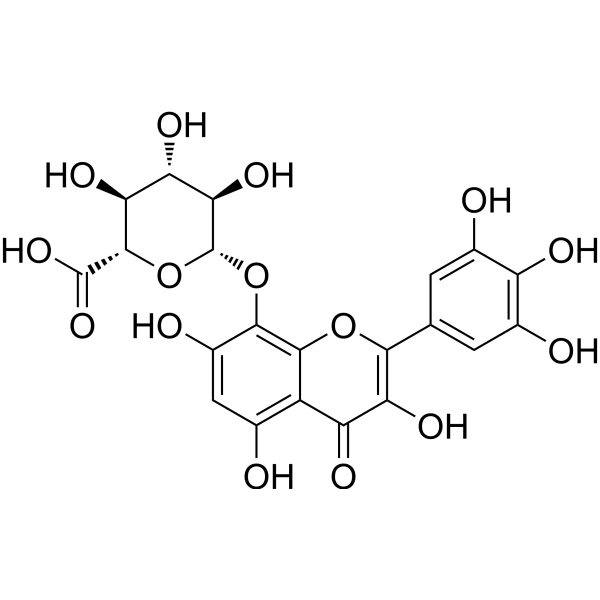 0 ImagesCat. No.: HY-N12472CAS No.: 1403981-95-2Floramanoside C shows 2,2-diphenyl-1-picrylhydrazyl scavenging and aldose reductase inhibitory activities.
-
4′-Hydroxyflavone
 0 ImagesCat. No.: HY-W319094CAS No.: 4143-63-94′-Hydroxyflavone (compound 50) can inhibit aldose reductase, with IC50 12 μM.
-
ALR2-IN-11
 0 ImagesCat. No.: HY-184283ALR2-IN-11 is a competitive aldose reductase (ALR2) inhibitor with a Ki value of 0.052 μM. ALR2-IN-11 can be used for the research of diabetic complications.
-
WF-3681
 0 ImagesCat. No.: HY-155164CAS No.: 105364-56-5WF-3681 (compound 1) is an aldose reductase inhibitor and a fungal metabolite.
-
Salfredin B11
 0 ImagesCat. No.: HY-N14401CAS No.: 165467-63-0Salfredin B11 is an aldose reductase inhibitor.
-
Floramanoside D
 0 ImagesCat. No.: HY-N12871CAS No.: 1487423-55-1Floramanoside D is a flavonol glycoside. Floramanoside D inhibits aldose reductase (IC50 is 2.2 μM), scavenges the 2,2-diphenyl-1-picrylhydrazyl (DPPH) (SC50 is 12.5 μM).
-
2-Chloro-1-(4-fluorobenzyl)-1H-benzo[d]imidazole
![2-Chloro-1-(4-fluorobenzyl)-1H-benzo[d]imidazole](https://file.medchemexpress.com/product_pic/hy-w011786.gif "Click to View 2-Chloro-1-(4-fluorobenzyl)-1H-benzo[d]imidazole Product Detail") 0 ImagesCat. No.: HY-W011786CAS No.: 84946-20-32-Chloro-1-(4-fluorobenzyl)-1H-benzo[d]imidazole is an inhibitor of larval settlement in marine organisms, demonstrating low toxicity while effectively inhibiting the metamorphosis of species such as barnacles, bryozoans, and polychaetes. 2-Chloro-1-(4-fluorobenzyl)-1H-benzo[d]imidazole also exhibits activity as an aldose reductase (ALR2) inhibitor, indicating potential therapeutic applications in diabetes-related complications.
0 ImagesCat. No.: HY-W011786CAS No.: 84946-20-32-Chloro-1-(4-fluorobenzyl)-1H-benzo[d]imidazole is an inhibitor of larval settlement in marine organisms, demonstrating low toxicity while effectively inhibiting the metamorphosis of species such as barnacles, bryozoans, and polychaetes. 2-Chloro-1-(4-fluorobenzyl)-1H-benzo[d]imidazole also exhibits activity as an aldose reductase (ALR2) inhibitor, indicating potential therapeutic applications in diabetes-related complications.
-
Alrestatin sodium
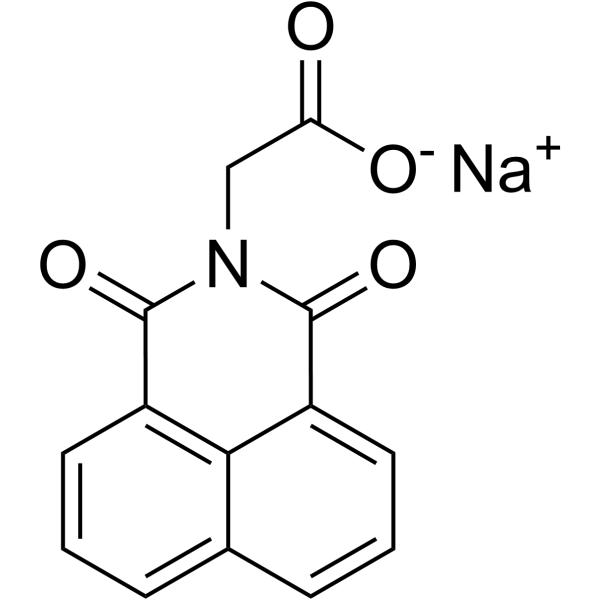 0 ImagesCat. No.: HY-B1202ACAS No.: 51876-97-2Synonyms: AY-22284AAlrestatin (AY-22284) sodium is an aldose reductase inhibitor. Alrestatin sodium reduces fructose levels in the uterine fluid of mice. Alrestatin sodium interferes with sperm capacitation and impairs fertilization function in mice. Alrestatin sodium decreases basal and tyramine-induced norepinephrine release in rat pancreatic specimens in vitro. Alrestatin sodium enhances glucose- and arginine-stimulated insulin secretion in vivo. Alrestatin sodium can be used in studies related to diabetes and reproductive diseases.
-
MK181
 0 ImagesCat. No.: HY-122177CAS No.: 314297-32-0MK181 is an aldose reductase (AR) inhibitor with IC50s of 0.71 μM and 4.5 μM for aldose reductase and AKR1B10, respectively. MK181 can bind into the external loop A subpocket of AKR1B10.
-
MK 319
 0 ImagesCat. No.: HY-116508CAS No.: 1462383-00-1MK 319 is a selective aldose reductase (AR) inhibitor with an IC50 of 0.3 μM. MK 319 can be utilized in diabetes research.
-
Carboxy finasteride
 0 ImagesCat. No.: HY-W739812CAS No.: 116285-37-1Synonyms: Finasteride carboxylic acidCarboxy finasteride is a metabolite of the 5α-reductase inhibitor Finasteride (HY-13635). Finasteride is biotransformed by cytochrome P450 (CYP3A4) and is successively oxidized to Hydroxy finasteride and Carboxy finasteride. Carboxy finasteride is the major metabolite in urine, while Hydroxy finasteride is the major metabolite in plasma.
-
ALR2/α-GLY-IN-1
 0 ImagesCat. No.: HY-181519ALR2/α-GLY-IN-1 is a potent dual-target inhibitor that targets aldose reductase ALR2 and α-glucosidase (IC50 values are 0.72 μM and 0.82 μM, respectively; Ki values are 1.67 μM and 1.37 μM, respectively). ALR2/α-GLY-IN-1 also acts as a DNA binder, which stably interacts with calf thymus double-stranded DNA through non-covalent interactions such as groove-binding mode and water-bridged hydrogen bonds. ALR2/α-GLY-IN-1 can be used in studies related to diabetes and its complications.
-
M 16287
 0 ImagesCat. No.: HY-165518CAS No.: 128851-55-8M 16287 is an orally active aldose reductase inhibitor, with an IC50 of 0.08 μM in rats and 0.25 μM in cattle. M 16287 improves lens fiber swelling and vacuolization, prevents galactitol accumulation, delays inositol depletion, inhibits glutathione reduction, restores the NADPH/NADP+ ratio to normal, and normalizes lens Na+ content and Na+/K+ ratio. M 16287 prevents galactose-induced cataract formation in rats. M 16287 improves motor nerve conduction velocity in diabetic rats, partially alleviates histopathological changes in the sciatic nerve, and inhibits sorbitol accumulation. M 16287 can be used in studies related to cataracts and diabetic neuropathy.
-
Fidarestat (Standard)
 0 ImagesCat. No.: HY-105185RCAS No.: 136087-85-9Synonyms: SNK 860 (Standard)Fidarestat (Standard) is the analytical standard of Fidarestat (HY-105185). This product is intended for research and analytical applications. Fidarestat (SNK 860) is an inhibitor of aldose reductase, with IC50s of 26 nM, 33 μM, and 1.8 μM for aldose reductase, AKR1B10 and V301L AKR1B10, respectively; Fidarestat (SNK 860) has the potential to treat diabetic disease.
-
Lidorestat (Standard)
 0 ImagesCat. No.: HY-106198RCAS No.: 245116-90-9Synonyms: IDD-676 (Standard)Lidorestat (Standard) is the analytical standard of Lidorestat (HY-106198). This product is intended for research and analytical applications. Lidorestat (IDD-676) is a potent, selective and orally active aldose reductase inhibitor with an IC50 of 5 nM. Lidorestat can be used for chronic diabetes complications. Lidorestat also improves nerve conduction and reduces cataract formation.
-
Alrestatin (Standard)
 0 ImagesSynonyms: AY-22284 (Standard)Alrestatin (AY-22284) Standard is the analytical standard of Alrestatin (HY-B1202). This product is intended for research and analytical applications. Alrestatin (AY-22284) is an aldose reductase inhibitor. Alrestatin reduces fructose levels in the uterine fluid of mice. Alrestatin interferes with sperm capacitation and impairs fertilization function in mice. Alrestatin decreases basal and tyramine-induced norepinephrine release in rat pancreatic specimens in vitro. Alrestatin enhances glucose- and arginine-stimulated insulin secretion in vivo. Alrestatin can be used in studies related to diabetes and reproductive diseases.

-
M79175
 0 ImagesCat. No.: HY-129685CAS No.: 82319-87-7M79175 is an aldose reductase inhibitor that can be used in the study of early diabetic retinopathy.




